
The Last True Studio Tape: Why Anthology 4 Feels Like the End of an Era
The end of recorded music and the rise of ultra personalised real time tracks.

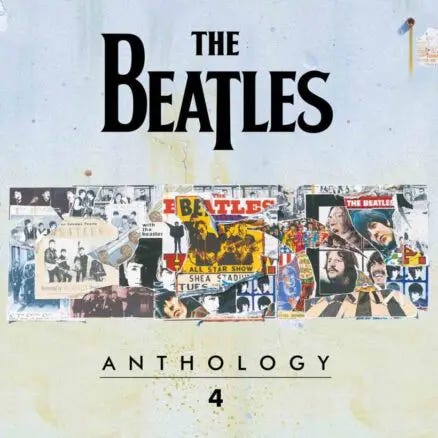
The Beatles’ Anthology 4 is remarkable not just because it exists, but because it captures something we’re about to lose forever, the sound of human beings making music together, in real time, in a room. Listening to it, released just yesterday (November 21, 2025), feels almost like digging up a fossil. Sure, it’s outtakes and demos. But it’s also evidence of a whole way of making music that’s basically disappearing while we watch.
When Giles Martin and his team used machine-learning tools to clean up John Lennon’s old demo vocals for “Now and Then” and the old rehearsal takes, they did something ground-breaking and also epoch ending. They saved the past, but they also signalled its end. The clarity you hear, the feeling that you’re practically standing in the studio with them, is the result of tech that marks a turning point. Yes, it uses AI, but not to invent new Beatles music, it’s there only to recover what was already on tape. Very soon, the idea that we can point to something and say, “That’s the real thing, we just cleaned it up,” won’t mean anything at all.
The Peak Before the Fall
Anthology 4 represents the high-water mark of old-school studio tech, and the timing is painfully poetic. We’ve hit the absolute peak of that sweet spot where analogue and digital overlapped perfectly. Analogue tape gave us the raw, risky, one-time-only magic of a real performance. Digital tools let us restore that magic without rewriting it.
It’s a last moment before everything flips.
Back then, the limitations made the music. Bands couldn’t tweak endlessly. They had to commit. Even the three-minute pop song wasn’t some artistic ideal, it came from the physical limits of vinyl singles. Constraints created style. Tape machines forced decisions. You can hear the stakes.
Then came digital recording in the ’80s, promising total freedom. And it delivered. What nobody predicted was that removing all constraints doesn’t liberate creativity, it changes what creativity is. A single take stops being a moment of truth and becomes just one option out of infinity. Urgency disappears.
And now, with real-time AI music models that can generate continuous audio at the pace you listen, guided by your input, we’ve moved into something completely different. Tools like Google’s Magenta RT can produce “music” that isn’t even a recording, it’s a live process and it might never end.
The Seismic Shift Is Already Happening
You too can feel the ground moving, and you’re not imagining it. The numbers make it obvious. By 2028, AI-generated music is expected to make up about 20% of traditional streaming revenue, and a staggering 60% of music library revenue. That’s not fringe. That’s a total redefinition of what “music” means as a business.
Right now, over a third of producers already use AI in their workflow. One in five musicians do too. The AI music market is exploding because once a model is trained, making a thousand more songs basically costs nothing. (there are figures, Google them)
And yes, there’s already an AI band, with over a million monthly Spotify listeners. They don’t tour, they don’t sleep, they don’t negotiate, and no one gets royalties. They’re not quite people and not quite machines, but they are the future.
This isn’t just an industry shift, it’s a cultural one.
The Authenticity Crisis Is Already Here
We’re not waiting for an authenticity crisis, it’s happening right now. Walter Benjamin’s old idea that mechanical reproduction erodes the “aura” of an original used to feel like a historical footnote. But he was pointing at something deeper, the way reproducibility itself erases the sense of something being genuinely one of a kind.
Today, digital reproduction is infinite. Deepfakes, cloned voices, AI singers, the Drake and Weeknd “Heart on My Sleeve” fiasco showed everyone how easily the line between real and fake collapses. We’re entering a world where knowing how to spot a fake becomes a basic life skill.
And once AI-made music becomes so good that you can’t tell the difference, what exactly do we lose?
Probably, everything that made human music human and we will have to redefine what human means.
Welcome to the Infinite Remix
My vision of endless remixes, on-demand AI “rehearsal tapes,” remixes generated on-demand, and music that evolves with your mood is not the future, it’s basically now. Real-time generative music systems already exist. They can riff, respond, evolve, and remix endlessly. Just give the marketing teams a few more years.
We’re heading into a world where a song won’t be a fixed thing anymore. It’ll be a stream, a process, something that recomposes itself every time you hit play. And not because some artist decided to remix it, but because the system is literally making it up in the moment, just for you.
Is This Good or Bad?
Honestly, uncertainty on this question is the only reasonable reaction. It’s not simply good or bad, it’s something our old categories don’t quite cover.
On the pessimistic side,
Music becomes separated from human effort. The imperfections that made The Beatles interesting, the cracks in John’s voice, the disagreements in the room, the messy humanity, none of that matters anymore. An AI can spit out infinite “new Beatles songs” without ever experiencing joy, frustration, or anything at all. Musicians lose income. Styles flatten out. Algorithms optimize for engagement, not expression.
And worst of all, we lose the joy of discovering something unexpected. Personalized AI streams only show you a reflection of your own taste. Culture becomes a mirror.
But there’s also a real upside, it’s easier than ever to create. Anyone can make music now. The tools genuinely empower people who never had access before. There’s a kind of democratization happening and we have no idea what wonders might emerge. one things for sure it wont just be synth based versions of disco like in the TV series Buck Rogers in the 25th Century, Google that, too.
But we should be careful, democratization-by-replacement is still replacement. If everyone uses the same models, the results may all converge. True diversity comes from constraints, not infinite options.
What We’re Really Losing
This isn’t really about whether AI music is “good.” The deeper loss is that authenticity becomes impossible to verify. Benjamin imagined a world where the idea of an original artwork fades. He had no idea how far that idea could go.
Music used to have a clear meaning of “original,” this room, this date, these people. Anthology 4 still captures that. But the world it captures is gone.
In a decade, asking “Is this music real?” will sound quaint, like asking in 1900, “Is this photograph real?” Culture will have moved on.
The Loss You Can’t Measure
What’s slipping through our fingers is the shared cultural object, the album your friend listened to, the song people discovered together. When every listening session generates its own version, culture fragments.
We also lose the thing that made art feel valuable, the evidence of human struggle. Art moved us because it carried human fingerprints, effort, risk, failure, personality, conflict. AI music can check every technical box except that one.
Without struggle, there’s no story.
So… What Do We Do Now?
Anthology 4 is a perfect closing note to the rock era. Not because The Beatles are ending again, but because the way music was made is ending. A few people in a room, trying, failing, arguing, nailing it, capturing the moment, that’s becoming a historical method.
Everything from here on out belongs to a new category.
The real question isn’t “Is AI music bad?” It’s…
What do we want to protect before the old way disappears completely?
What depends on authenticity, on scarcity, on the risk of failure, on human presence?
We don’t need to ban AI. But we do need spaces where the human way of making music continues to matter.
Because once it’s gone, we won’t get it back.
For now, Anthology 4 gives us one last artifact. A tape that proves humans once did this, together, in real time, with skin in the game. That tiny sliver of reality captured in sound is the thing we’re losing.
And that’s the shift I’m feeling.